
Forging a Critical Deepwater Connection with the Ellicott® Series 970 Dragon Dredge
The Problem: Treacherous Shoals and Hurricane Erosion
Sebastian Inlet, known as one of the most dangerous in Florida, faced a decade-long struggle to balance navigational safety with environmental protection.
Hurricane Damage: Massive erosion from the 2004 hurricane season stripped sand from local beaches, leaving them vulnerable to further storm surge.
Lack of Connectivity: Historically, Sebastian Inlet was the only inlet on Florida’s east coast that did not have a deepwater channel connecting it directly to the Intracoastal Waterway (ICW).
Navigational Hazards: Boaters were forced to traverse shallow zones, frequently running aground, damaging boats, and even risking lives in the inlet’s powerful currents.
Environmental Sensitivity: The area is a critical habitat for threatened Johnson’s seagrass. Previous dredging attempts were blocked by the U.S. Army Corps of Engineers due to concerns over habitat destruction.
The Solution: The Ellicott® Series 970 Dragon® (C-WAY)
After securing federal permits, the Sebastian Inlet District utilized an Ellicott® Series 970 Dragon® model cutter suction dredge, owned by SubAqueous Services Inc., to execute a multi-phase $5 million restoration project.
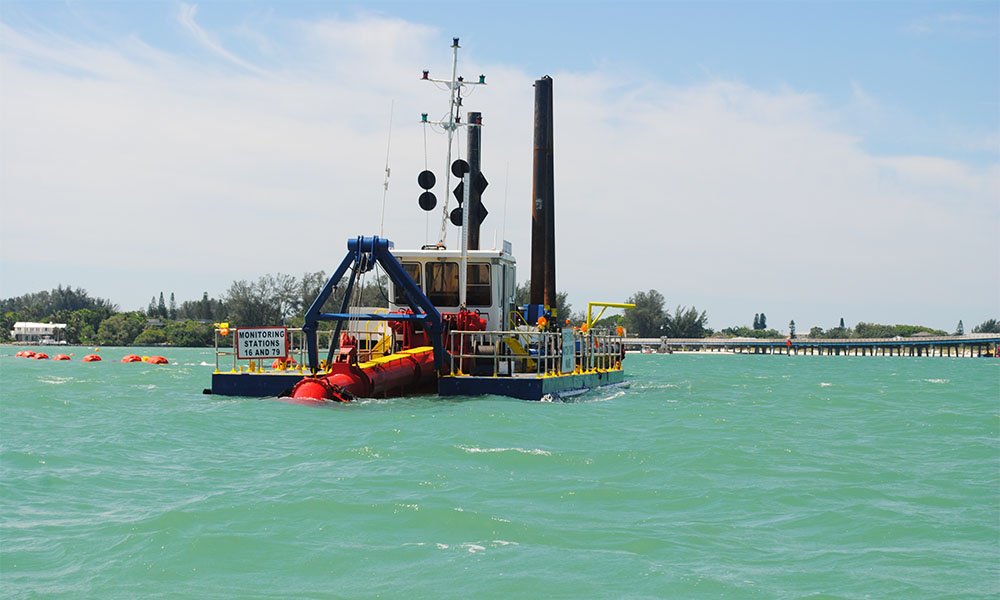
- Phase I – Beach Restoration: The C-WAY commenced operations by excavating sand from a 42-acre underwater “sand trap” inside the inlet. The dredge pumped high-quality sand onto 2.5 miles of hurricane-eroded beach to the south.
- Phase II – Navigation Channel: The dredge was tasked with carving out a new 3,120-foot-long channel (100 feet wide and 9 feet deep). This first-ever deepwater link provided safe passage from the Atlantic Ocean to the ICW.
- Environmental Mitigation: To offset the impact on Johnson’s seagrass, the project included a sophisticated mitigation plan. Seagrass in the channel’s path was harvested and used to repair nearby “propeller scars” in the lagoon bottom.
- Hurricane Recovery Funding: Because the dredging repaired erosion caused by 2004 hurricanes, FEMA provided approximately 90% of the funding for the sand-trap portion of the project.
The Outcome: Safety Restored and Ecosystem Flushed
The successful application of Ellicott® technology resolved a 25-year infrastructure need for the region.
- Safe Boating Passage: For the first time, boat captains can navigate a designated 9-foot-deep channel, significantly reducing the risk of groundings and propeller damage to sensitive shoals.
- Dune and Beach Protection: Thousands of cubic yards of sand were successfully returned to the shoreline, creating a wider buffer that protects upland property from future ocean surge.
- Lagoon Vitality: The new channel facilitates better saltwater flushing from the Atlantic into the Indian River Lagoon, helping to mitigate pollution and sustain the estuary’s unique biodiversity.
- Strict Timeline Compliance: The efficiency of the Series 970 allowed the work to be completed before May 1st, adhering to strict environmental deadlines to avoid interference with sea turtle nesting season.